
Ever since the discovery of radioactivity by Henri Bec- querel in 1896 and the development of the technique of radiomet- ric dating 13 years later, by Lord Rutherford, not only could age determinations of certain strata be carried out, but also elements were seen to have a finite existence. This raised the question of where the elements came from in the first place and the search for a naturalistic mechanism for the origin of matter, and the universe in general was pursued with new vigor. In the first half of the 20th century, astronomers were concluding that stars were the source of complex atoms that were being produced by nuclear processes in their interior. The process of atomic fusion could construct com- plex atoms from simple ones. This insight raised more questions: where did the stars come from and where did the universe come from? In the second half of the 20th century, a number of theories were put forward to address these questions.
The model that has come to be most widely accepted is called the Standard Model, as it is apparently most consistently supported by astronomical observations. It is also generally known as the ‘Hot Big Bang’ model and can be summarized as follows5:
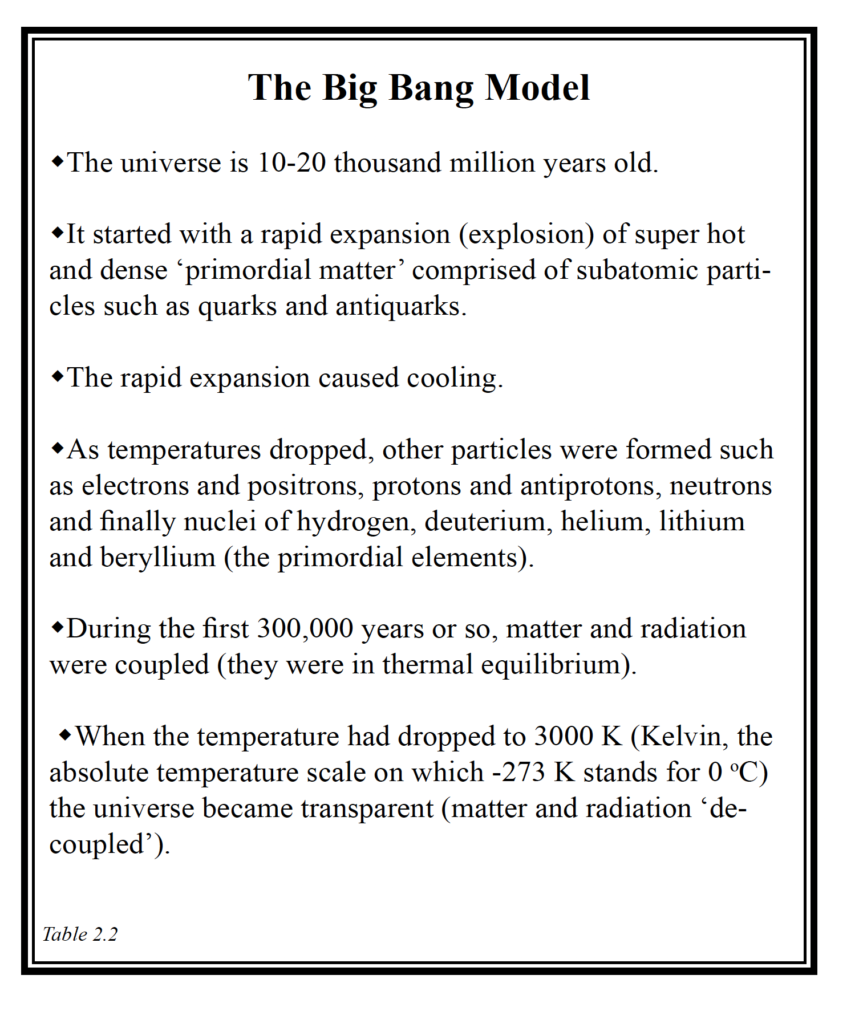
Table 2.2
This cosmological theory of the origin of the universe was largely formulated by Edwin Hubble and is based on certain astro- nomical observation and on philosophical assumptions. In the formu- lation of the theory, Hubble assumed two basic principles: General Relativity and the Cosmological Principle, and these principles lie at the heart of the Big Bang Theory.
Before the development of modern astronomical instru- mentation, there had been no way of determining the status of some of the components of the universe. In fact, the question as to whether other galaxies formed part of the Milky Way system or lay outside of the Milky Way had not been settled by the dawn of the 20th century and was a question of hot debate in 1921. In 1924, Hubble (through his study of Cepheid stars in other galax- ies) showed that the majority of nebulae (as all nebulous objects and galaxies were called at that stage) indeed lay great distances outside our galaxy. Moreover, by studying the spectral lines emitted by these galaxies he noted that they showed red shifts, and be- cause of his underlying philosophical convictions, concluded that all galaxies were moving away from our own Galaxy, the Milky Way. Hubble also observed increasing red shifts for galaxies at increasing distances from the sun. This was the conclusion because the fainter a galaxy (and therefore presumably, the further away), the bigger the red shift in its spectrum (therefore, presumably, the faster it must be moving away from the earth) and this was so no matter in which direction one looked. It thus appeared as if the entire universe was dilating away from an expansion center, which, to all appearances, was the earth itself. If the universe is expanding, then it must have been smaller in the past, and so the Big Bang theory was born. The astronomical observations that fit in with the Big Bang theory of an initial explosion, an expansion, and subsequent formation of all the matter in the universe are:
- Almost all galaxies show red shift
- There exists a background radiation (a presumed remnant of the initial explosion) with a temperature of about 3 K, the so-called microwave background radiation (MBR)
- There is an observed cosmic abundance of hydrogen, helium, lithium and beryllium in the universe.
As noted earlier, the Big Bang theory is not only based on these empirical observations, but is intertwined with philosophical assumptions and there are numerous eminent scientists that do not agree with the interpretation of the data at hand. Let us examine the various components of the theory and the interpretations of the data.